How ISPs Save Thousands of IPs Using /31 Subnetting
CIDR /31 subnetting is one of the most practical yet misunderstood concepts in networking. Unlike traditional subnets, it allows both IP addresses to be used in point-to-point connections, eliminating waste and maximizing efficiency. This guide breaks down how /31 works, why it exists, and how real-world networks use it to save thousands of IP addresses.
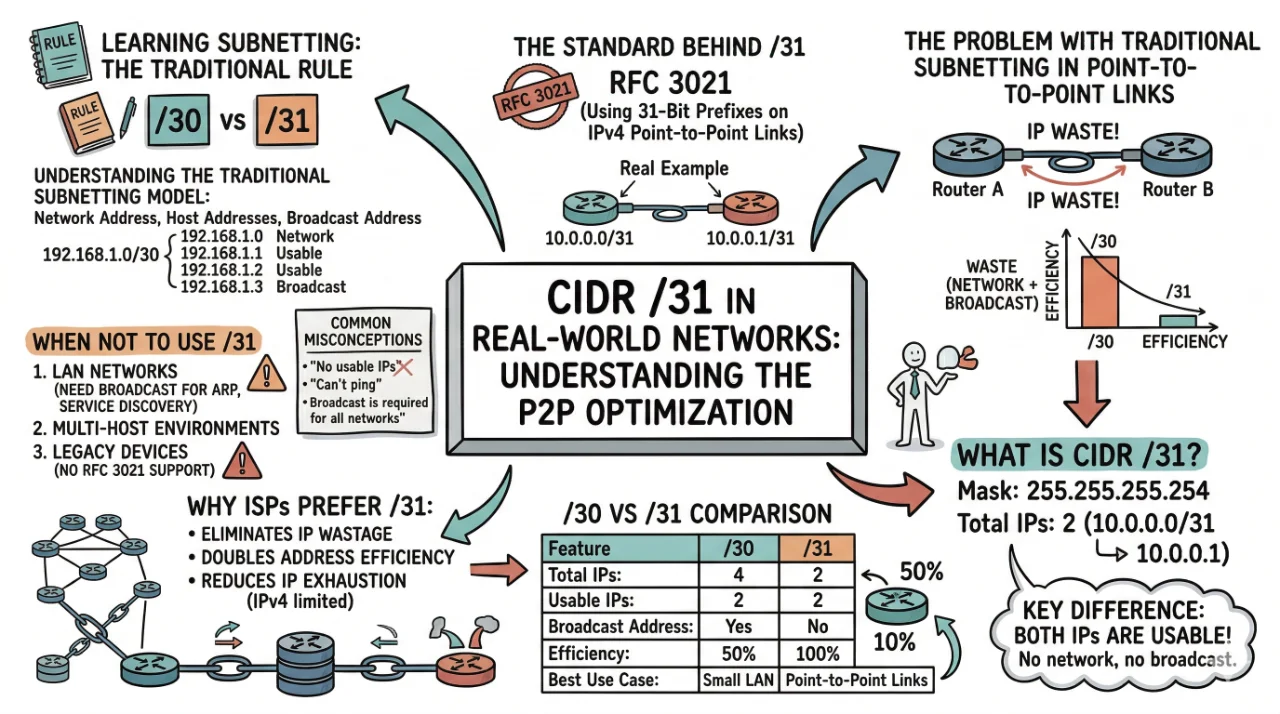
When you first learn subnetting, one rule gets repeated everywhere: every subnet has a network address and a broadcast address, meaning you always lose two IPs. Then suddenly you encounter /31, and everything seems to break that rule.
So what’s going on? Is /31 a trick, an exception, or something misunderstood?
In this article, we will break down CIDR /31 in a practical, real-world way, especially focusing on point-to-point (P2P) connections, where it is actually designed to be used. By the end, you’ll not only understand it conceptually, but also how and why it’s used in real networks like ISP backbones.
Understanding the Traditional Subnetting Model
Before diving into /31, let’s briefly revisit how traditional subnetting works.
In a normal subnet, there are three types of IP addresses:
- Network Address – Identifies the subnet itself
- Host Addresses – Assigned to devices
- Broadcast Address – Used to send packets to all devices in the subnet
For example, take a /30 subnet:
192.168.1.0/30
- 192.168.1.0 → Network Address
- 192.168.1.1 → Usable Host
- 192.168.1.2 → Usable Host
- 192.168.1.3 → Broadcast Address
So even though there are 4 IP addresses, only 2 are usable.
This model works well in LAN environments where multiple devices need to communicate and broadcasting is useful. But it becomes inefficient in certain scenarios.
The Problem with Traditional Subnetting in Point-to-Point Links
Now imagine a point-to-point connection, such as:
- Router A connected directly to Router B
That’s it. Only two devices exist on the link.
If you use a /30 subnet:
- You get 2 usable IPs (good)
- But you waste 2 IPs (network + broadcast)
At small scale, this may not matter. But in real-world scenarios:
- ISPs may have thousands of such links
- Enterprise WANs may have hundreds of interconnections
This leads to massive IP address wastage.
This is exactly the problem that /31 was designed to solve.
What is CIDR /31?
A /31 subnet means:
- Subnet mask: 255.255.255.254
- Total IP addresses: 2
Example:
192.168.1.0/31 → IPs: 192.168.1.0 and 192.168.1.1
Now here’s the key difference:
In /31, both IP addresses are usable.
There is:
- No network address
- No broadcast address
Why /31 Works: The Core Logic
The traditional concept of network and broadcast addresses is based on one assumption:
There are multiple hosts in the network that need to communicate.
But in a point-to-point link:
- There are only two devices
- Communication is always one-to-one
- Broadcasting is not required
So:
- No need for a broadcast address
- No need to reserve a network identifier
This allows both IP addresses to be treated as host addresses.
RFC 3021: The Standard Behind /31
The use of /31 for point-to-point links is officially defined in:
RFC 3021 – Using 31-Bit Prefixes on IPv4 Point-to-Point Links
This RFC explicitly states that:
- Both addresses in a /31 subnet can be used for communication
- Broadcast is unnecessary in P2P environments
Modern routers and networking devices fully support this behavior.
Real Example: Router-to-Router Link
Let’s look at a practical example:
| Device | IP Address | Subnet |
|---|---|---|
| Router A | 10.0.0.0 | /31 |
| Router B | 10.0.0.1 | /31 |
Here:
- Router A uses 10.0.0.0
- Router B uses 10.0.0.1
Both devices can communicate directly without any issue.
How Communication Works Internally
A common question is:
“How does communication work without a broadcast address?”
Here’s what happens:
- Each router knows there is only one peer
- Traffic is always sent directly to that peer
- Protocols like ARP still function but are simplified
Since there are no multiple hosts, the need for broadcast disappears entirely.
Comparison: /30 vs /31
| Feature | /30 | /31 |
|---|---|---|
| Total IPs | 4 | 2 |
| Usable IPs | 2 | 2 |
| Broadcast Address | Yes | No |
| Efficiency | 50% | 100% |
| Best Use Case | Small LAN | Point-to-Point Links |
Clearly, /31 is much more efficient for P2P connections.
Why ISPs Prefer /31
In large-scale networks:
- Thousands of router-to-router links exist
- Each link traditionally wastes 2 IP addresses
Using /31:
- Eliminates IP wastage
- Doubles address efficiency
- Reduces IP exhaustion pressure
This is especially important in IPv4, where address space is limited.
Where /31 is Commonly Used
- ISP backbone networks
- Enterprise WAN links
- MPLS core connections
- Router-to-router Ethernet links
It is rarely used in LAN environments.
When NOT to Use /31
Despite its advantages, /31 is not suitable everywhere.
1. LAN Networks
LANs require broadcast for:
- ARP
- Service discovery
2. Multi-Host Environments
If more than two devices exist, /31 cannot work.
3. Legacy Devices
Older networking equipment may not support RFC 3021.
Common Misconceptions
“/31 has no usable IPs”
Wrong. In P2P context, both IPs are usable.
“You can’t ping in /31”
Incorrect. ICMP works normally between the two endpoints.
“Broadcast is required for all networks”
Not true. It is only required in multi-host networks.
Configuration Example (Cisco Style)
Here’s a basic configuration:
interface GigabitEthernet0/0
 ip address 10.0.0.0 255.255.255.254
 no shutdown
On the other router:
interface GigabitEthernet0/0
 ip address 10.0.0.1 255.255.255.254
 no shutdown
Once configured, both routers can communicate normally.
Advantages Summary
- Maximum IP efficiency
- Ideal for P2P links
- Reduces IPv4 wastage
- Widely supported in modern networks
Disadvantages Summary
- Not suitable for LANs
- Requires device compatibility
- May confuse beginners due to exception behavior
Practical CCNA Exam Insight
In exams, you may see tricky questions like:
“How many usable IPs are there in a /31 subnet?”
Correct answer:
- 2 usable IPs (in point-to-point context)
Always remember the context matters.
Conclusion
CIDR /31 is not a hack or a shortcut—it is a well-defined, standardized optimization specifically designed for point-to-point communication. By removing the unnecessary concepts of network and broadcast addresses in a two-device environment, it allows both available IP addresses to be used efficiently.
In real-world networking, especially in ISP and large enterprise environments, this small optimization leads to significant savings in IPv4 address space. Understanding /31 is not just about passing an exam—it reflects how modern networks are engineered for efficiency and scalability.
Discussion
💬 0 comments